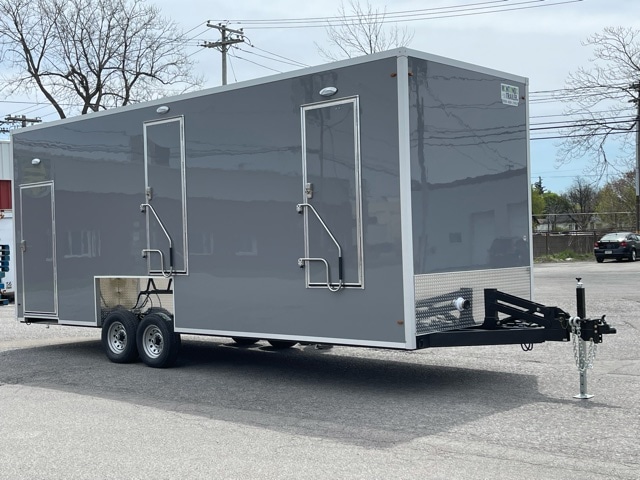
Luxury Restroom Trailers vs Portable Toilets
August 26, 2025
Rent Out Portable Bathroom Trailers
September 10, 2025
If you’re shopping Used Restroom Trailers in the U.S. & Canada, you want clean, dependable units that won’t eat your budget—or your weekends—with surprise repairs. This guide walks you through where to look, how to evaluate the condition, what to ask sellers, and how to avoid common pitfalls so you can secure a trailer that’s ready to work from day one.
Quick Takeaways
-
Prioritize specialist sellers who regularly build, rent, or refurbish restroom trailers.
-
Ask for maintenance logs, high-resolution photos, and a written condition report.
-
Verify the plumbing, electrical, and structural systems before paying.
-
Match the trailer’s floor plan and climate package to your Region and use case.
-
Keep a short list of upgrade must-haves (touchless fixtures, ADA access, winterization) so you can negotiate smartly.
What “Used” Really Means: Used vs. Refurbished vs. As-Is
Not all Used Restroom Trailers are the same. Understanding the label protects your budget.
Used
A trailer that’s been in service—often in an event or rental fleet. Expect normal wear, but also verify that it has been properly maintained and serviced. Request a service history and a current inspection report.
Refurbished
A used trailer that’s been reconditioned—think fresh coatings, updated fixtures, resealed tanks, repaired floors, and checked systems. Refurbished can mean a longer life and lower near-term repair costs.
As-Is
Sold in current condition, no guarantees. It might be a bargain for experienced buyers with a team who can wrench, but as-is, it can hide costly surprises if you’re new to trailers.
Where to Find Used Restroom Trailers (U.S. & Canada)
Below are the most reliable sources, ranked by their consistency in delivering quality and transparency.
1) Direct from a Specialist Manufacturer or Builder
Manufacturers and builders who design and rent restroom trailers tend to know what fails, what lasts, and how to properly restore a unit. When they release used inventory, you get purpose-built machines with known maintenance histories and access to support. Start your search at the source: used restroom trailers and general restroom trailers listings at Montondo Trailer. Embedding early with a trusted specialist adds confidence to your shortlist.
2) Established Rental Fleets
Rental fleets typically retire units on a scheduled basis. The upside is documented service, standardized parts, and operators who are familiar with the equipment. You’ll often find mid-life trailers with predictable wear patterns. Ask for retirement reasons, detailed service logs, and photos of high-traffic areas (floors, thresholds, door latches).
3) Authorized Dealers and Niche Brokers
Reputable dealers specializing in mobile sanitation will thoroughly screen trades and consignments. They can coordinate pre-delivery inspections, minor refurb work, and logistics. Vet any broker with buyer testimonials, years in business, and clarity on who owns the trailer (dealer inventory vs. consignment).
4) Marketplaces and Auctions (Use Caution)
Public marketplaces can surface deals, but also risk. If you buy here, protect yourself with a pre-purchase inspection, a video walk-through, and a firm bill of sale that clearly outlines the included equipment (spare tire, hoses, steps, and winterizing kit). If a seller can’t provide clear photos of the undercarriage, tanks, and electrical panel, that’s a red flag.
The “Vetted Seller” Checklist
Use this quick rubric before you invest time in a listing:
-
Offers VIN, model year, and serial tags in photos
-
Provides maintenance records (pumps, brakes, tires, bearings, seals)
-
Shares 50+ photos or a video walk-through showing roof, frame, tanks, panel, fixtures
-
Clearly states tank sizes, number of stations, and power requirements
-
Willing to complete a live video demo (pump running, lights on, AC/heat cycling)
-
Has replacement parts guidance and a support contact
-
Provides a written condition report and a purchase agreement
Inspection Roadmap: How to Judge Condition Like a Pro
You don’t need to be a mechanic—just be methodical and stick to a sequence. Bring a flashlight and a notepad. If purchasing remotely, please request the shots and clips listed below.
Frame, Body, and Exterior
-
Frame & Tongue: Look for straight rails, intact welds, no deep rust, and sound crossmembers.
-
Coupler & Jack: Inspect for smooth operation and any ovaling in the coupler.
-
Roof & Seams: Check sealant lines, vent boots, and edge trim; look for chalking or fresh reseal work.
-
Doors & Latches: Verify smooth closure, tight weatherstripping, and firm hinges.
-
Skirting & Steps: Solid attachment, even gaps, and non-slip surfaces.
Axles, Brakes, and Tires
-
Axles: Note the capacity tags and compare them to the GVWR; check for leaks at the seals and inspect the tires for even wear.
-
Brakes: Verify the operation of the electric brakes; inspect the drums or discs for scoring.
-
Tires: Confirm date codes (DOT), no sidewall cracking, and tread depth. Always ask for a matching spare.
Plumbing & Tanks
-
Fresh, Grey, or Black Tanks: Request information on tank material (poly vs. aluminum), the condition of fittings, and proof of leak-free operation.
-
Pumps: Test water pump and macerator (if present). Listen for steady operation; pulsating or cavitation noise can signal issues.
-
Valves & Hoses: Inspect gate valves for smooth sliding and seals for drips.
-
Winterization: In cold regions, confirm bypass valves, heat tracing, and insulated tank bays.
Electrical & Climate
-
Power: Identify shore power plug type and amperage; test GFCI outlets.
-
Panel & Breakers: Look for tidy wiring, labeled circuits, and intact bonding.
-
Lighting: Verify interior/exterior lights, exit signs, and emergency lighting.
-
HVAC: Cycle AC and heat. Check thermostat response and condensate drainage.
-
Battery/Converter: If equipped, confirm battery date and converter charging voltage.
Interior & Fixtures
-
Floors & Subfloor: Step every square foot; feel for soft spots or squeaks.
-
Walls & Ceilings: Look for stains (past leaks), delamination, or bulging panels.
-
Stalls & Doors: Latches should close securely; check for gaps that compromise privacy and security.
-
Sinks & Faucets: Run hot and cold; look for steady flow and tight seals.
-
Toilets & Urinals: Many units use RV-style foot pedals—ensure positive seal and quiet return.
-
Touchless Upgrades: Verify the presence of confirm sensors, batteries, and response speed if installed.
Match the Trailer to Your Use Case
Think about where, how often, and who will use the trailer.
-
Event Operators (Festivals, Weddings): Prioritize elegant finishes, odor control, and quick-clean surfaces.
-
Construction & Industrial: Opt for durable floors, anti-slip steps, and simplified service access.
-
Disaster Relief & Municipal: Look for ADA access, redundant power options, and easy winterization.
Climate Readiness for the U.S. & Canada
From the Gulf Coast to the Prairies, climate dictates reliability.
-
Cold Regions (Midwest, Northeast, Prairies, Atlantic Canada): Seek heated tank bays, insulation, heat tracing on lines, and storm-rated doors.
-
Hot Regions (Southwest, Southeast): Higher-capacity AC, roof coatings, and ventilation upgrades matter.
-
Coastal Areas (Pacific & Atlantic): Corrosion-resistant hardware, sealed seams, and UV-stable materials help extend the product’s lifespan.
Size, Capacity, and Floor Plans
Don’t overbuy, but don’t under-spec either.
-
Stations: Common layouts include 2 to 10 stations. More stations mean shorter lines at events.
-
ADA/Accessibility: If you host public events, an ADA-compliant layout broadens access and inclusion.
-
Tank Sizes: Bigger tanks reduce service visits; confirm your pump-out intervals.
-
Power & Water: Clarify shore power vs. generator, city water vs. onboard storage, and hose lengths.
Key Benefits of Buying Used (Table)
| Benefit | Why it matters | What to ask the seller |
|---|---|---|
| Lower capital cost | Free budget for upgrades and marketing | Total price, taxes, delivery, and any refurb line-items |
| Faster availability | Get a trailer on the calendar sooner | Ready date, current location, lead time for minor fixes |
| Proven reliability | Field-tested layouts and components | Maintenance records, parts list, and known failure items |
| Upgrade potential | Add touchless fixtures, LED, odor control | Upgrade menu, costs, and turnaround time |
| Eco-friendly reuse | Keeps a quality unit in service longer | Refurb scope (coatings, floors, sealing, fixtures) |
| Resale value | Well-kept trailers hold value | Comparable sales, brand reputation, and condition grading |
Red Flags That Mean “Keep Scrolling”
-
Only a handful of photos or no interior shots
-
Fresh paint with zero explanation of what was underneath
-
Inconsistent answers about tank sizes or power
-
“Just needs a small pump”—often a larger plumbing issue
-
Title problems or reluctance to share VIN
-
A bargain price with pressure to wire funds fast
Smart Questions to Ask Every Seller
-
“What service did you perform in the past 12 months?”
-
“What repairs would you tackle if you were keeping it?”
-
“Can you show me a live tank fill and drain?”
-
“What parts are new (tires, brakes, pump, HVAC, battery)?”
-
“Who can I call for support after purchase?”
Photos & Video: What to Request Before You Travel
-
Full exterior walk-around at eye level and low angles
-
Undercarriage and frame from the side and rear
-
Panelboard close-up with breakers labeled
-
Pumps running (audio helps!), all fixtures flowing
-
Roof seams and vent boots
-
Each station shows floor, threshold, door latch, and privacy gaps
Paperwork You Need to See
-
VIN and weight ratings; match to title/registration
-
Bill of Sale listing included equipment and any warranty
-
Maintenance logs and parts receipts
-
Owner’s manual or quick-start guide
-
Any regional compliance documentation (especially if crossing the U.S.–Canada border)
Transport & Border Tips (U.S.–Canada)
-
Confirm your tow vehicle’s capacity and brake controller compatibility.
-
Check provincial/state rules on trailer brakes and lighting.
-
When importing/exporting, clarify customs paperwork in advance
-
Verify your insurance covers transit across borders.
-
Plan your route and overnight parking—restroom trailers attract attention; choose secure stops.
Upgrade Ideas That Stretch the Value
-
Touchless faucets and flush controls for hygiene and speed
-
LED lighting with warm color temp for events
-
Enhanced odor control (vents, fans, carbon filters)
-
Non-slip floor overlays for rugged worksites
-
Tank level sensors with remote display
-
Cold-weather kit: insulation, heat tracing, door sweeps
Used vs. New: A Simple Decision Path
-
If you need a trailer immediately and can live with a near-match layout → buy a used unit that passes inspection.
-
If you have unique brand or layout requirements and time to wait → spec a new build.
-
If your budget sits between the two → buy used and allocate a small refurb fund for upgrades.
Budgeting Without Guesswork
Rather than chasing “cheap,” aim for the lowest total cost over 12 to 24 months. That means factoring in:
-
Purchase price, taxes, and delivery
-
Immediate repairs and upgrades
-
Seasonal kits (winterization) if you operate in colder regions
-
Spares: tires, a pump rebuild kit, bulbs, fuses
-
Branding (wraps, signage), cleaning supplies, odor media
Warranty, Returns, and Support
On used equipment, policies vary. Push for:
-
A short functional warranty on critical systems
-
A written return window or exchange policy (even if limited)
-
Phone support for first 30–90 days
-
Parts guidance with recommended suppliers and part numbers
Why Start with Montondo Trailer
Montondo builds, rents, and refurbishes mobile sanitation equipment—so buying through Montondo means access to people who know the platforms inside and out. If you want a vetted path to Used Restroom Trailers, start your shortlist here: used restroom trailers. If you eventually scale to shower, laundry, or combo units, Montondo can advise on fit and timing so your fleet grows in the right order.
After-Purchase Care: A 30/60/90 Plan
Day 1–30
-
Deep sanitize: tanks, lines, stalls
-
Replace consumables (filters, bulbs, seals)
-
Test every circuit; label breakers
-
Document parts numbers for pumps, seals, and valves
Day 31–60
-
Install priority upgrades (odor control, touchless fixtures)
-
Schedule pump maintenance and bearing inspection
-
Stock spare hoses, gaskets, and fuses
Day 61–90
-
Review service history; plan seasonal prep
-
Train crew on winterization and de-winterization
-
Build a cleaning SOP with checklists for turns
Your Shortlist Workflow (Step-by-Step)
-
Define must-have specifications: stations, ADA compliance, climate control, and tank sizes.
-
Build a list of 5–7 promising units from specialist sources.
-
Request full photo/video packages, as well as a live demo.
-
Arrange a third-party or in-house inspection.
-
Negotiate price, upgrades, and delivery.
-
Close with clean paperwork; schedule handoff and training.
-
Deploy with a 30/60/90 checklist and stock of spares.
Lightly Optimized Anchor Examples (Low Intensity)
When evaluating used restroom trailers, keep a close eye on the availability of support and parts. If you need a proven partner for refurbishment and delivery across the U.S. & Canada, start with restroom trailers and ask about currently available used inventory and upgrade timelines. A short initial call can save weeks of back-and-forth later.
FAQs
1) How old is “too old” for a used restroom trailer?
Age matters less than care. A five-year-old unit with steady maintenance can outperform a newer one that has been neglected. Focus on frame integrity, tanks, pumps, and HVAC.
2) Are the used units sanitary enough for upscale events?
Yes—when reclaimed correctly. Look for deep cleaning, resealed tanks, odor control, and touchless options. A clean, intact floor and bright lighting boost perceived quality.
3) What power do I need on-site?
Many trailers are equipped with standard shore power and GFCI protection. Request the exact plug type and amperage, as well as any generator recommendations for remote locations.
4) How do I handle winter operations in Canada or cold U.S. states?
Select units with heated tank bays, insulation, and heat tracing for optimal performance. Train staff on proper winterization and carry extra seals and hose gaskets.
5) What should I budget after purchase?
Plan for initial sanitation, minor repairs, and any upgrades that matter to your clients (such as touchless fixtures, odor control, and lighting). Keep a small reserve for unexpected items.

Jack Montondo founded Montondo Trailer in 2014. Jack has worked hard to make his business a success, paving the way to making it a multi-million dollar. Montondo Trailers is a premier design and manufacturing leader in Custom Trailers. Here at Montondo Trailer, we have become an industry-leading manufacturer of Custom Trailers. Through the efforts of our expert team of engineers, designers, and sales personnel, we are here to ensure that our clients come out with a trailer that they could only dream of. We are constantly innovating and developing new ways to ensure our trailers are the best on the market. We firmly believe our dedication to quality sets us apart from our competition.